
Hot Reads
One Week In, Rutgers' $24 Million Roster Just Lost to a Team Making a Fraction of It
By Fritch · September 8, 2026
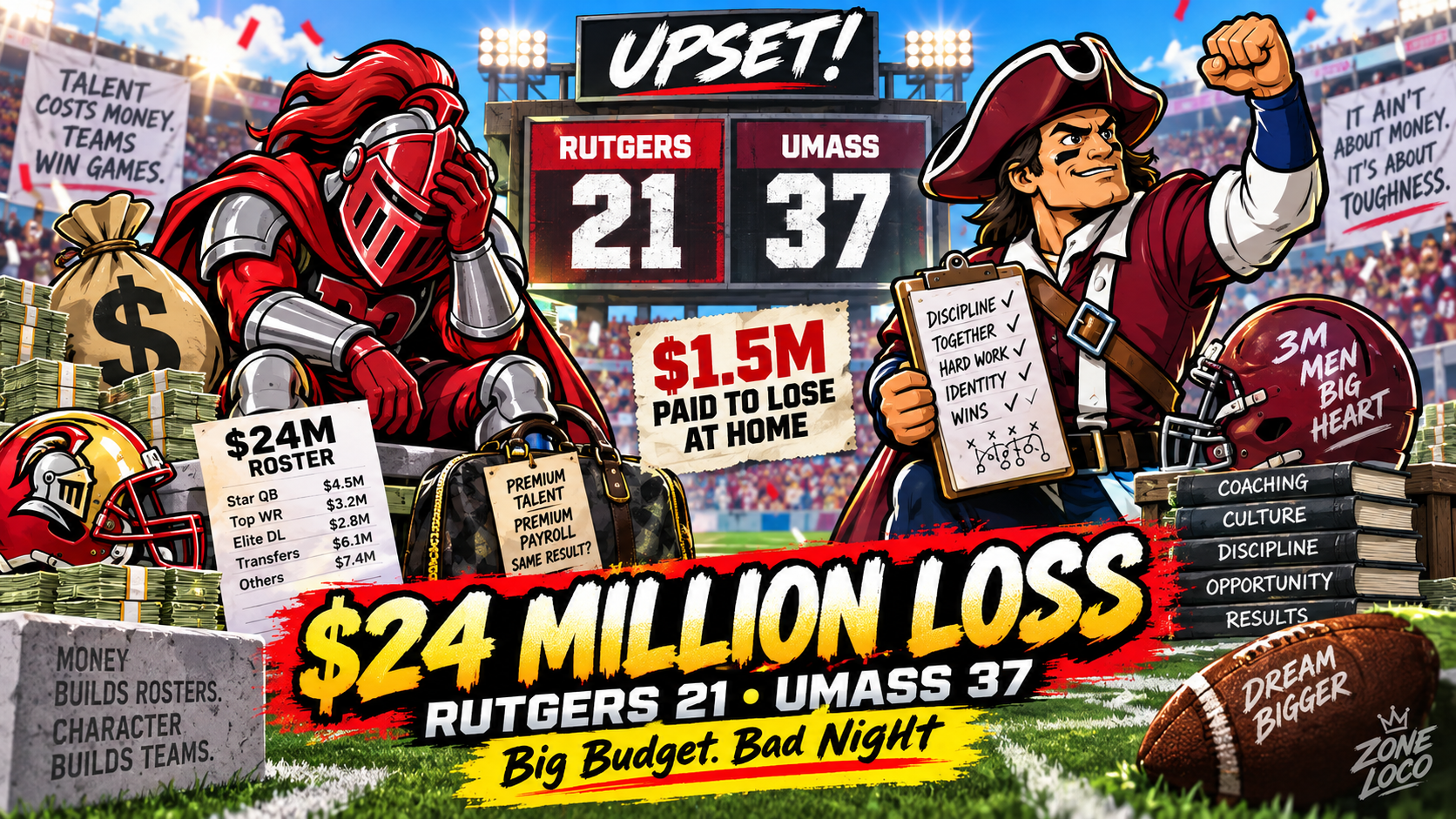
Rutgers Paid UMass $1.55 Million to Show Up. UMass Took the Money and the Win.
Let's start with the funniest number from Week 1.
It isn't 37-21.
It's $1.55 million.
That's how much Rutgers agreed to pay UMass to come to Piscataway and play a football game.
You know how these games are supposed to work.
The Big Ten school writes the check.
The little guy shows up.
Everybody gets some television inventory.
The home crowd gets a comfortable win.
And the visiting athletic department goes home a little richer after providing three hours of live tackling-dummy service.
UMass apparently missed that part of the contract.
The Minutemen took Rutgers' $1.55 million, took over Rutgers' stadium, beat the Scarlet Knights 37-21 and presumably remembered to take the check with them on the way out.
And somehow, it gets funnier.
UMass entered the game on a 16-game losing streak.
They went 0-12 last season.
They hadn't beaten an FBS opponent since 2023.
They were nearly 30-point underdogs.
And MAC coaches had picked them to finish dead last in the conference.
Thirteenth out of thirteen teams.
Rutgers wasn't supposed to lose this game.
Rutgers was barely supposed to sweat.
Instead, after Rutgers scored first and went up 7-0, UMass scored the next 30 points.
That's when upset starts becoming too polite a word.
UMass outrushed Rutgers 200 yards to 27.
Twenty-seven.
Rutgers averaged barely more than a yard per carry.
UMass sacked Rutgers quarterbacks five times.
Rutgers didn't record a single sack.
UMass forced four turnovers.
And the Minutemen held the football for more than 36 minutes.
That's not sneaking out the back door with an upset.
That's walking through the front door, eating everything in the refrigerator and asking where you keep the good towels.
And Then You Find Out Who Coached UMass
Here's my favorite part.
The man who did it was Joe Harasymiak.
If that name sounds familiar to Rutgers fans, there's a reason.
He was Greg Schiano's defensive coordinator at Rutgers from 2022 through 2024.
Think about that.
Rutgers basically paid its former defensive coordinator $1.55 million to come back to his old workplace and ruin everybody's Thursday night.
College football is beautiful.
Now Let's Talk About the Money
This is where the game gets more interesting than just laughing at Rutgers.
Because financially, these programs aren't supposed to be playing the same sport.
When UMass hired Harasymiak, the program was reportedly guaranteed roughly $3 million in NIL and revenue-sharing resources for football in 2026.
Rutgers lives in an entirely different neighborhood.
Independent estimates have Rutgers' football roster spending somewhere around $21 million, with the median Big Ten roster estimated even higher.
Those aren't perfectly audited payroll numbers. Third-party NIL money is still difficult to track precisely.
But we don't need an accountant to see the difference.
We're talking about something in the neighborhood of a seven-to-one financial advantage.
Then there's the coaching money.
Greg Schiano is scheduled to make roughly $6.75 million this season.
Joe Harasymiak's reported compensation has been around $1.36 million.
Read that again.
Rutgers is paying its head coach alone more than twice the amount UMass was reportedly guaranteed for its entire football player-compensation pool.
And Rutgers isn't exactly pinching pennies elsewhere.
The athletic department spent more than $46 million on coaching salaries across all sports while dealing with an enormous athletics budget deficit.
So if college football were simply a spreadsheet competition, we never would've needed to play this game.
Rutgers wins.
Print the standings.
Everybody go home.
Except somebody forgot to tell UMass.
Here's Where the Easy Narrative Gets Complicated
My first instinct watching this was pretty simple:
UMass developed its players.
Rutgers spent more money.
Coaching beat cash.
There's only one problem.
That's not exactly what happened.
UMass overhauled its roster too.
After going 0-12 in Harasymiak's first season, the Minutemen entered 2026 with 56 new faces, including around 30 transfers.
Only a small group of players remained from the roster Harasymiak originally inherited.
So this isn't some romantic anti-portal story.
Quite the opposite.
UMass used the portal.
UMass turned over its roster.
UMass went shopping too.
It just went shopping with a much smaller credit card.
And that might actually make the result more interesting.
Because the lesson isn't that continuity beat money.
The Lesson Might Be That Roster Construction Beat Roster Cost.
At least for one night.
There's a difference.
Money Can Buy Players. It Can't Make Them Fit.
Let me make one thing clear before somebody screenshots one paragraph and tells me I don't understand modern college football.
Money matters.
A lot.
Ohio State, Oregon and the other programs spending enormous amounts on football rosters aren't doing it because their athletic directors lost a bet.
Elite talent costs money.
Depth costs money.
Quarterbacks cost a lot of money.
And over a 12-game season, programs with vastly greater resources are going to have enormous structural advantages.
I'm not arguing otherwise.
What Rutgers-UMass showed is something different.
Having More Money Doesn't Automatically Mean You're Spending It Better.
Rutgers apparently had several times the player-compensation resources of UMass.
And for one night, UMass had:
- The better running game
- The better pass rush
- The better turnover margin
- The better game plan
- And the better football team
That's the part that should interest every athletic director outside college football's financial elite.
You might not be able to buy Ohio State's roster.
Fine.
That doesn't mean you have to build a bad one.
Give Joe Harasymiak Some Credit
There's another problem with treating this entirely as Rutgers embarrassing itself.
UMass deserves some credit for causing the embarrassment.
Harasymiak isn't some guy they found coaching flag football at the YMCA.
Before UMass, he was Rutgers' defensive coordinator.
Before that, he coached at Minnesota.
Before that, he went 20-15 as Maine's head coach, won a conference championship and took Maine all the way to the FCS semifinals.
Then he took the UMass job.
And went 0-12.
Which isn't exactly the résumé line you put in bold type on the recruiting brochure.
But instead of pretending everything was fine, Harasymiak and UMass changed things.
They attacked the portal.
They rebuilt the roster.
They found new players.
They changed the personnel.
And in the first game of Year 2, a team that could barely score last season walked into a Big Ten stadium and put up 37 points.
Maybe it's a one-night miracle.
Maybe UMass goes right back to being UMass next week.
We don't know yet.
And that's why I don't want this one result to prove more than it actually proves.
Now We Find Out Whether It Means Anything
If UMass goes out over the next month and gets knocked around by the bottom half of the MAC, then we'll know what this was.
Rutgers had a nightmare.
UMass had the night of its life.
We all laughed.
End of story.
But if UMass starts winning?
Then this becomes something worth studying.
Because plenty of programs around college football are staring at the same problem.
They aren't going to have $30 million rosters.
They aren't going to outbid Ohio State.
They aren't going to win every portal auction.
So what do they do?
Maybe the answer isn't pretending they're rich.
Maybe it's evaluating better.
Maybe it's developing better.
Maybe it's finding players who actually fit what you want to run.
Maybe it's spending your limited money in the right places.
And maybe it's still doing the oldest thing in football:
Coaching the hell out of the players you've got.
Money Raises the Ceiling. It Doesn't Guarantee the Result.
That's really where I land after watching Rutgers and UMass.
Money matters.
Talent matters.
Resources matter.
But there's still a difference between buying players and building a football team.
Money can buy a quarterback.
Money can buy linemen.
Money can buy depth.
But money can't call a defense.
Money can't protect the football.
Money can't make an offensive line block.
Money can't make 85 guys believe in what the coaching staff is asking them to do.
And apparently, money can't stop a team you paid $1.55 million from beating you in your own stadium.
For one Thursday night, Rutgers had the bigger budget.
UMass had the better football team.
And the Minutemen got paid handsomely to prove it.