
Fix College Football
Stop Calling Them Student-Athletes. Start Calling Them What They Are.
By Fritch · September 8, 2026
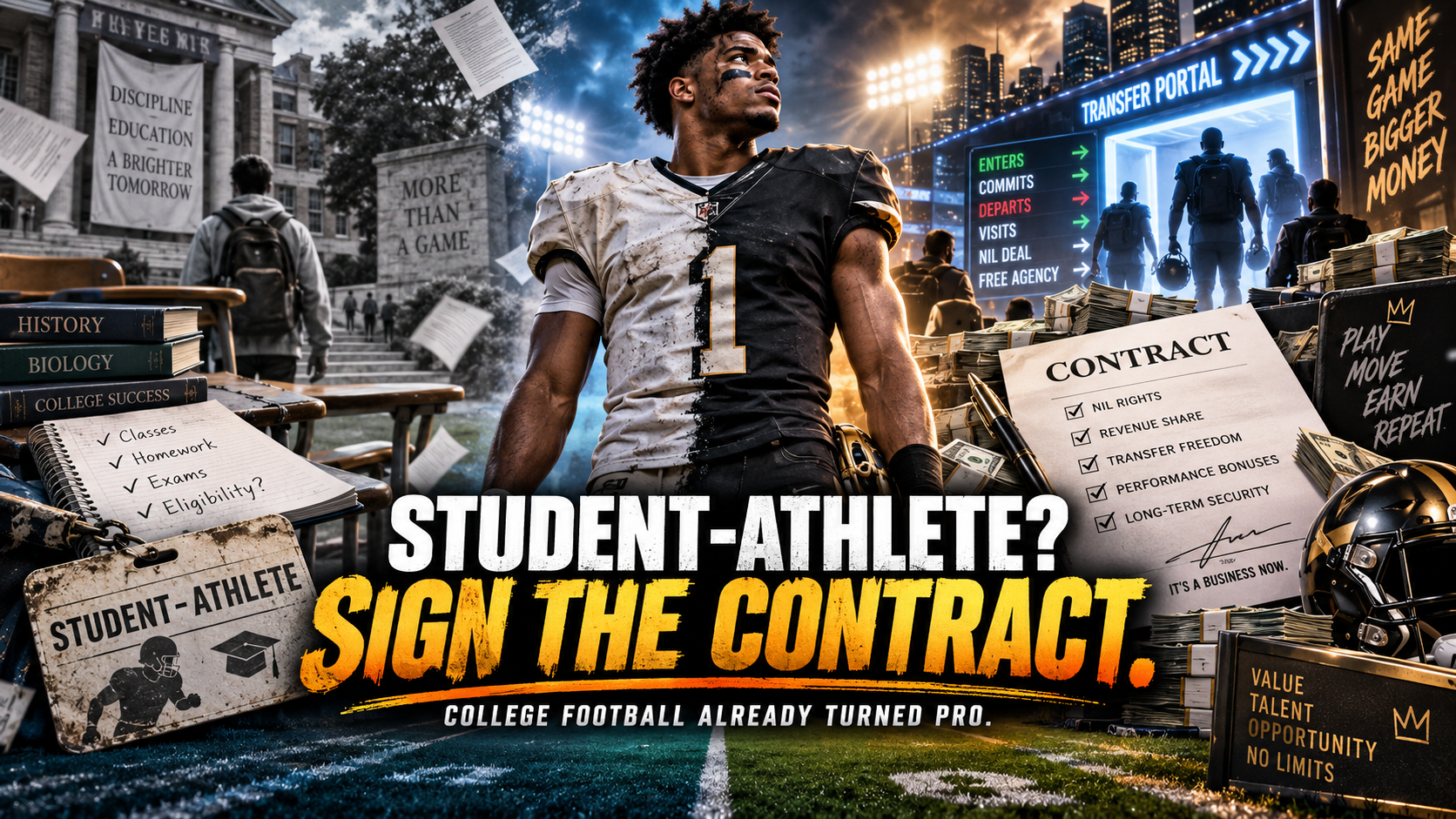
Let's stop pretending. Nobody is fooling anybody anymore.
Quick question: when's the last time you heard a football player got ruled out for the season because his grades slipped? Go ahead, think about it. Take your time. I'll wait.
Right — you can't remember one either, because "student-athlete" stopped meaning anything a long time ago. It's a label the NCAA keeps using so it can talk about "amateurism" with a straight face while these same kids sign $4 million deals and get recruited like free agents. Nobody is failing out. Nobody is getting benched for a bad midterm. The "student" part is decorative at this point — a little badge they slap on the jersey so nobody has to say the word "employee" out loud.
So here's a wild idea: if you're going to pay someone like a professional, recruit them like a professional, and trade them like a professional, maybe — and stay with me here — you make them sign an actual contract like a professional. Groundbreaking stuff. Somebody get me a Nobel committee.
The Money Already Turned Pro. Everyone Else Is Just Catching Up.
Let's look at the numbers, because they do the yelling so I don't have to.
Schools can now share up to $20.5 million directly with athletes — and that's before a single dollar of third-party NIL money shows up from collectives and boosters, who apparently have never met a wallet they didn't want to open. Power Conference programs are running a median roster cost of about $23 million for 2026. Half of SEC teams are north of $30 million. This is a payroll. Say it with me: payroll. Some programs are pushing rosters into the $40-50 million range. Clemson's grouped in a tier estimated at $25-35 million, right alongside Florida State, Louisville, and SMU — basically the ACC's "we're not Miami but we're not broke either" club. Washington's Demond Williams Jr. signed a reported $4 million revenue-sharing deal. Then transferred days later anyway. More on that in a second, because it's basically the whole argument in one story.
You cannot pay someone seven figures and then act shocked when they behave like someone who just got paid seven figures. That's not a scandal. That's Tuesday in every other industry on planet Earth.
Free Agency, Minus the Part Where Anyone Actually Runs It
Here's where it gets fun, in the way a car crash is fun to watch from a safe distance.
More than 10,500 players across all divisions hit the transfer portal in the 2026 cycle. Over 6,700 of those were Division I, crammed into a single 15-day window — which is somehow both an eternity for a coaching staff and nowhere near enough time to figure out where 1,200 kids are going to sleep next fall. More than 1,200 FBS scholarship players were still sitting in the portal, unsigned, after the window slammed shut. That's not a market. That's a game of musical chairs where somebody forgot to bring enough chairs, or a plan, or an adult in the room.
The NFL does this exact same thing — player movement, big money, high stakes — and somehow doesn't combust every year. Why? Because they've got contracts, a cap, and a union that actually enforces the rules on both sides. College football has the money and the chaos, and skipped the part where you build a system to handle either.
Schools Already Want Contracts. They Just Want the Kind Where Only One Side Has to Follow Them.
This is my favorite part, honestly, because it's the sports equivalent of writing "no takebacks" on a napkin and expecting a judge to enforce it.
Reported revenue-sharing deals increasingly come with buyout clauses — real financial penalties if a player leaves early. Very professional. Very league-office energy. Georgia is currently suing a former defensive lineman to collect a $390,000 buyout after he transferred to Missouri. Arbitration. Lawyers. The whole production. Washington's deal with Demond Williams Jr. reportedly blocked him from entering the portal at all. He entered the portal anyway. Days later. The ink was still wet. Arkansas publicly announced it would start enforcing buyout language — the same week a high-profile quarterback hit the portal. Timing is everything.
Here's the problem: every one of these stories is about a school going after a player. Funny how that works. When was the last time you saw a school get dragged into arbitration for cutting a kid loose the second a new coordinator wanted "his guys"? Exactly. If the contract only bites in one direction, it's not a contract. It's a leash. And somebody needs to say that part out loud.
Real Contracts Need Real Consequences — For the Schools Too
If we're doing this, we're doing it both ways or we're not doing it at all.
Right now a school can sign a kid, promise the world, then a coaching change happens and suddenly that same kid gets frozen out of the offense until he "decides" to transfer on his own. Nobody pays a dime for that. That's not amateurism, that's a loophole with a fight song.
A real system needs:
Guaranteed money — like an NFL signing bonus. Some of it is owed no matter what happens next, coaching change or not. School-side buyouts — a program cuts a player under contract without cause, or effectively pushes him out? The school pays. Not the kid. The people running a $150 million athletic department. A neutral referee — not the school, not a booster collective grading its own homework. Somebody who doesn't have a dog in the fight deciding who breached what.
You can't build a professional system where only one party — the one still figuring out how to do laundry — is on the hook for breaking it.
Okay, But Do We Even Have Enough Money for All This?
Here's the part nobody wants to talk about at the tailgate: is there actually enough money to go around, or are we just building a nicer casino on top of a foundation that's already cracking?
Do the math on one program. Player payroll: $25-40 million. Now stack coaching payroll on top. A top head coach alone can run $10-13 million a year — Kirby Smart tops the market at $13.3 million, which is more than plenty of NFL coordinators make. A full assistant staff at places like Ohio State runs $15.3 million, with a handful of other programs in the $8-12 million range. Add analysts, recruiting staff, support personnel, and you're looking at $25-30 million in coaching costs alone — for one sport, at one school.
So for a single football program, we're talking somewhere in the neighborhood of $50-70 million total, before anyone else in the athletic department gets a sandwich.
And that math is already breaking everything downstream:
The $20.5 million revenue-sharing cap covers every sport at a school, but football is eating almost all of it — one estimate has football taking 85-90% of a school's entire athlete-compensation budget. Everyone else is fighting over the crumbs like it's the last slice at a family barbecue. More than 415 college sports programs have been cut, merged, or reclassified since March 2024. More than 40 Division I Olympic sports programs — swimming, tennis, track — got the axe in just over a year, because apparently a backup safety's NIL bag matters more than an entire sport existing. Nearly 40% of Team USA's 2026 Winter Olympics roster came out of that same NCAA pipeline that's currently being fed into a wood chipper. Third-party NIL spending is projected to roughly double, from $1.17 billion in 2024 to $2.55 billion in 2026 — almost all of it pouring into football and men's basketball on top of the revenue-sharing cap, not instead of it.
If we bolt contracts, buyouts, and guaranteed money onto this system without fixing where the money actually comes from, football and basketball are going to keep eating every other sport's lunch until there's no lunch left. You want to "professionalize" the sport? Fine. But build in a funding floor for everybody else first, or we're not professionalizing college athletics — we're just picking which sports get to die quietly so a five-star quarterback can get a bigger check.
Congress Is Already Circling This. They Just Won't Land the Plane.
And look, I'm not out here just yelling into the void — Congress is already poking at this. There's a real bill, the Protect College Sports Act of 2026, bipartisan, Cruz and Cantwell out front, that passed committee this summer 19-9. Some outlets are calling it the plan to "save college sports," which, sure, fine, close enough to what everyone's already calling it in their head.
Here's what it actually does: federal NIL rules to replace the 50-state mess, agent registration with fees capped at 5%, disclosure requirements, and — this is the interesting part — a $22.5 million retention fund for schools to pay to keep their own players from bolting in the portal. That fund can grow to $27.5 million if the school also puts real money into NIL for women's and Olympic sports. Translation: even Congress noticed football and basketball are eating everyone else's lunch, and they built in an incentive to knock it off.
So credit where it's due — that's basically a legislative version of the funding floor I'm asking for above. Good. Necessary. Not nothing.
But notice what it doesn't do. It doesn't touch employee status. It doesn't create standardized player contracts. It doesn't build in a buyout that runs against the school, not just the player. It gives the NCAA and conferences legal cover to enforce their own rules — which is nice for them — but it stops well short of the two-way accountability system college football actually needs. It's guardrails, not a contract. A speed bump, not a stop sign.
Which is fine as a first step. Just don't let anyone tell you it's the whole fix. It isn't.
The Fix
If schools are going to pay players like professionals, everybody needs to act like it — including the schools.
Real, standardized contracts. Length, money, terms — spelled out clearly, reviewed by somebody who isn't grading their own homework. Consequences for breach, on both sides. Player walks, he pays. School cuts him without cause or forces him out, the school pays. Novel concept: fairness. A real market window. Something with actual structure, not a 15-day free-for-all that leaves over a thousand kids standing at the bus stop with no ride home. A funding floor for everyone else. A protected chunk of the budget football and basketball can't touch, so paying the stars doesn't mean quietly euthanizing swimming and track. Actual bargaining power. The NFL works because players negotiated the rules alongside the league, not underneath it. College athletes deserve the same seat at the table before anyone hands them a "pro-style" contract with none of the pro-style protections.
Call it what it is. These aren't student-athletes anymore — nobody's flunking their way out of a starting job, nobody's missing a game for academic probation, and pretending otherwise is how we got a system with all the money of a business and none of the rules. Give it a real contract. Give it real consequences. On both sides.